Websites for trades businessesthat capture enquiries properly.
A website for a trades business has to show in seconds what you do, how far you travel and how to reach you — and take enquiries in a way you can answer without chasing details. OsAI builds it from €990, and you see the draft before you commit.
Nine things a trades website has to get right.
A generic company site introduces you. A trades site gets opened on a phone, on the move, usually with a specific problem in mind: cold heating, a new bathroom, a leaking roof.
Structured enquiries
Instead of “please call me back”, you get the service, the location and how urgent it is. One option is a form with a service picker and photo upload, so you see the situation before you drive out.
Services and service area
What do you do, what don't you do, and how far do you travel? Clear service pages answer that before the first call and show Google what your business stands for.
Emergency call-outs and availability
If you offer an emergency service, it belongs at the top, with a number that dials with one tap on a phone. If not, it's clear when you can be reached.
Project photos
Finished bathrooms, laid floors, neatly run pipework: photos from real jobs convince more than stock images.
Master craftsman status and qualifications
Master certificate, guild membership, manufacturer certifications: often the reason someone contacts you. They belong visibly on the site, not in the small print.
Reviews from your Google profile
Your Google Business Profile is often the first touchpoint. The website links to or shows your reviews there, and name, address and phone number match exactly on both.
Built for phones
Customers search on the move, and you want to be able to show the site on the job too. That means large buttons, readable text and no pop-up covering the phone number.
Fast loading
In a basement or out in the countryside, reception is often poor. A lean site still loads, and loading speed counts for Google too.
Mandatory legal information
Legal notice and privacy policy are there from the start, with the details that apply to your business, such as chamber of crafts or register entry. The form only asks for what's needed.
What an enquiry can look like before you call back.
A sketch for a plumbing and heating business. What gets asked depends on your trade.
- Service tapped instead of typed out
- Photo shows the situation on site
- Urgency separates emergencies from quote requests
- Postcode shows right away whether the job is in your area
SANITECs Haustechnik, plumbing and heating from Winnenden.
OsAI's first paid project: a trades business from the Rems-Murr district near Stuttgart. The new website has been live since 31 August 2026.
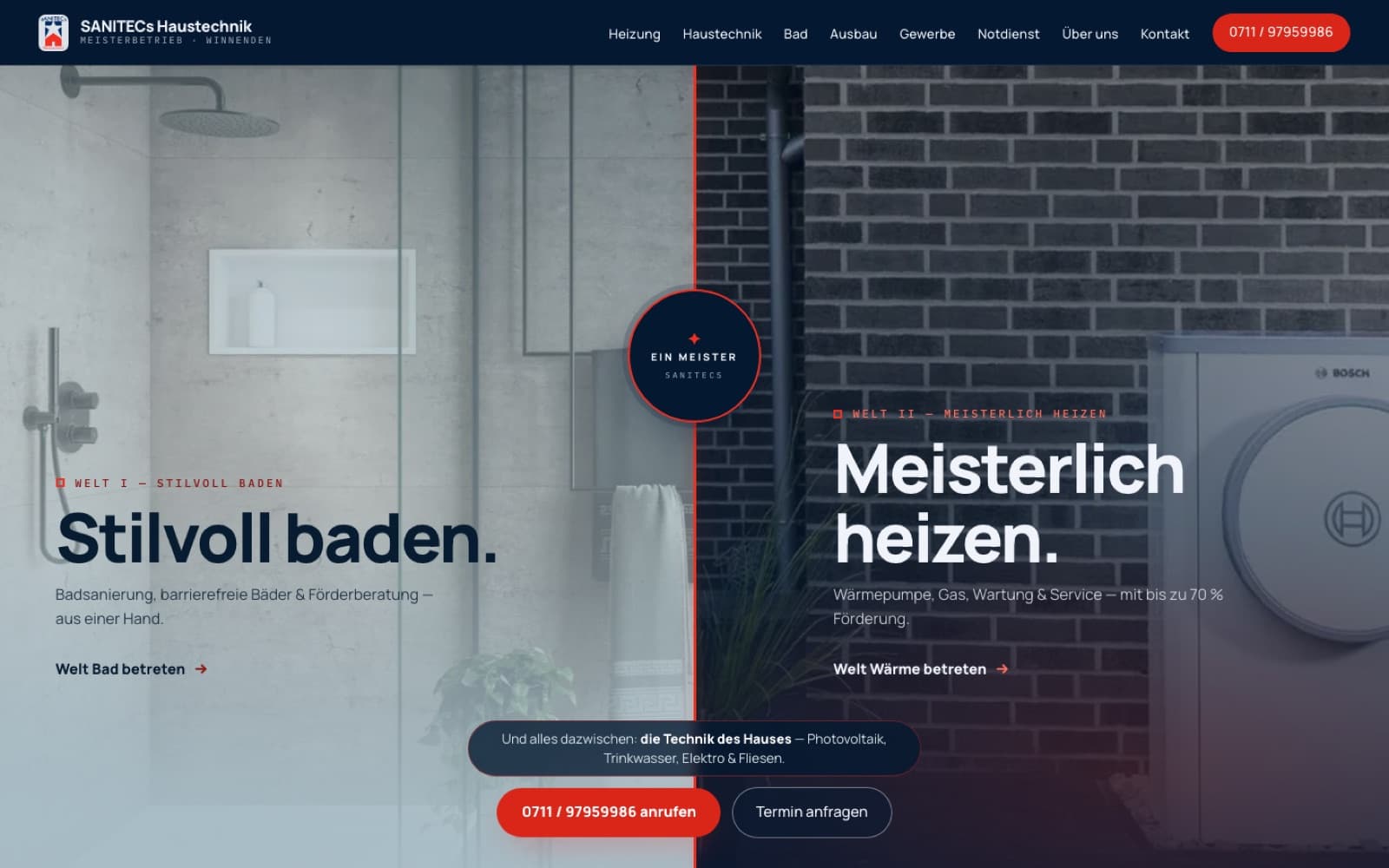
- Website
- SEO foundations, so Google classifies the site correctly
- GEO foundations, so AI search tools like ChatGPT understand the business too
We don't quote enquiry or ranking figures here as long as there are no reliable ones.
Where AI saves trades businesses real time.
The website is the front door. Some of what piles up in the office afterwards can be automated — the final sign-off stays with you.
Quote from a voice note
After the site visit, you speak briefly into your phone. That becomes a draft quote with line items from your own price list, which you check and send.
See the demoPre-sorting enquiries
Incoming enquiries get sorted by service and urgency, and missing details are asked for. The emergency sits at the top, next spring's quote request further down.
More on AI automationCapturing receipts
Material invoice or fuel receipt: a photo is enough. Supplier, date and amount are read out and filed as a booking suggestion, and you confirm with one tap.
See the demoThis isn't part of the website price. A single automated workflow usually costs €1,500–6,000, at a fixed price agreed before work starts.
From €990, and you see the draft first.
All prices are final: as a small business under § 19 of the German VAT Act (UStG), OsAI doesn't charge VAT.
Built from the draft you saw before signing, with a legal notice and contact form. Smaller sites land closer to the starting price, larger ones above it.
Changes such as new project photos, updates and a fixed point of contact once the site is live.
Four steps
- Talk
A short chat about your business: trade, service area and how enquiries come in today.
- Draft before contract
The site gets built as a finished draft before you sign anything.
- Revision
Your feedback and your own photos go in until it fits.
- Launch
The site goes live, with ongoing care if you want it.
Questions trades businesses ask first.
Answered honestly, including where there's no guarantee.
Do I need my own website as a tradesperson if I already have a Google profile?
Your Google Business Profile matters, but you only have limited control over what it shows. On your own website you explain your services in detail, show project photos and take enquiries the way you need them. Both together are strongest: the profile points to the site, the site confirms the profile. Neither guarantees more enquiries.
What does a website for a trades business cost?
From €990 for the website, ongoing care from €49 a month. These are final prices, since OsAI is a small business under § 19 UStG and doesn't charge VAT. Where exactly the price lands depends on scope — you know the draft and the price before you commit.
How quickly is the site live?
The draft comes first, before you commit to anything. How long it then takes to go live depends mainly on how quickly photos, details and feedback come in. We agree the timeline before you sign — there are no blanket promises.
Who writes the copy?
OsAI writes the copy for the draft, based on what you tell us and what's known about your business. You check it and correct anything technical, because you know your trade best. Ongoing writing after launch isn't included in the starting price.
Can I upload or change project photos myself?
We settle that before the build, because it affects how the site is made. You can send new photos and have them added as part of ongoing care. A section where you manage project photos yourself is also possible — but it changes effort and price.
See the draft first,
then decide.
Write a few lines about what your business does and where you work. On site around Stuttgart, remote across Germany.
Reply usually within a few business days.