Web app development for small businesses.
A web app is a program of your own that runs in the browser — on computer, tablet and phone, with nothing to install. When no off-the-shelf software fits your workflow, I build a small one of your own. Fixed price, fixed timeline — then it's yours.
When a custom web app is worth it.
A custom web app is worth it when a task comes up often and off-the-shelf software only handles it with workarounds that cost time every week. If a standard program genuinely fits, that's usually the better choice — and I'll tell you so.
Off-the-shelf software is enough if …
- your workflow runs the way it does in most businesses.
- the tool already exists ready-made, for example for accounting or booking.
- the licence costs less in the long run than building your own.
A custom web app is worth it if …
- your pricing rules or forms are too specific for ready-made programs.
- spreadsheets, paper slips and retyping fill the gap today.
- customers should enter or look up something themselves.
14 in-house applications are live.
Shown here with image and name are the in-house tools — all four live and reachable.

Roast My Website
Reviews a website automatically, point by point.

AI Time Machine
Moves a photo into another decade with AI.

Immo-Expo
Turns property data into its own presentation page.
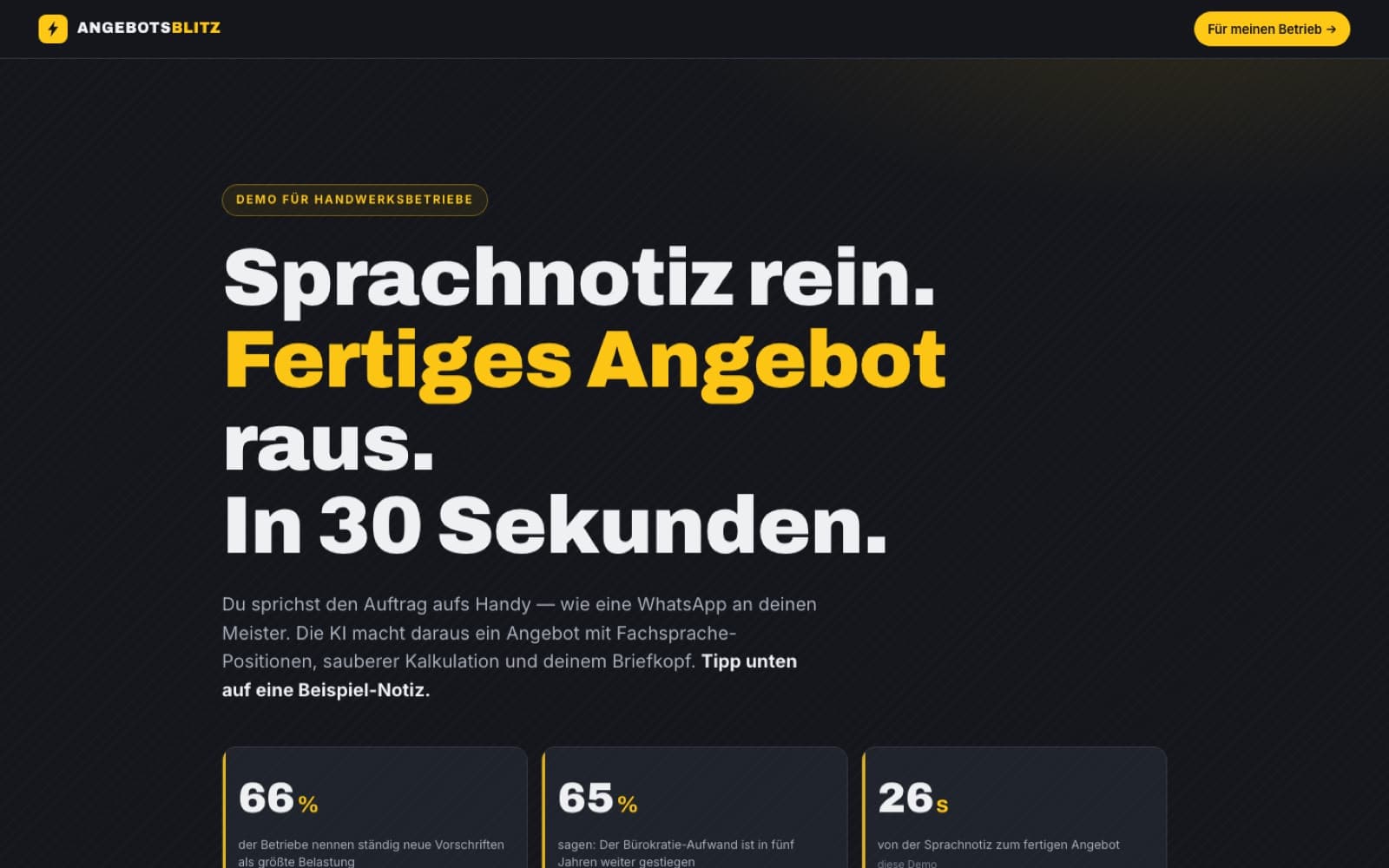
Angebots-Blitz
Turns a few bullet points into a finished quote.
What in-house web apps handle day to day.
No made-up client projects — three applications I built myself, ready to try.
Angebots-Blitz
After the appointment you speak briefly into your phone. The app turns that into line items priced from your own list — you check it and send it off.
See the demoProjekt-Akte
Emails, quotes, photos and notes of a project sit in one place. You ask in plain words and get the answer with its source.
See the demoRoast My Website
You enter an address, the app checks the site point by point. Built to turn visitors into enquiries.
Try it yourselfOne small tool that's missing in the business.
Not an off-the-shelf builder — an application for exactly your task.
A calculator for your own pricing
Your price rules, your margins, your edge cases — as a form instead of a spreadsheet only you understand.
A client area
A login where clients see their status, documents or appointment — without you answering every enquiry by hand.
A handover checklist
A digital form for the site or the job that's saved straight away as a record — no paper slip that gets lost.
A quote flow
Clients enter their own details, you get back a finished, calculated quote — instead of transcribing every figure by hand.
From €3,900.
The price depends on scope. Before the build starts, a fixed price is set — no timesheets, no surprise afterwards.
The exact amount is set once the task is scoped, not guessed beforehand.
What cost and timeline depend on
Scope
How many views and forms the app needs and whether there are logins with their own permissions.
Connections
Whether data is exchanged with calendar, accounting or inventory — and whether there's an interface for it.
AI features
Whether the app should understand speech or documents. That adds build effort and ongoing costs with the AI provider.
Existing data
Whether lists, prices or customer data need to be imported and tidied up first.
Price and timeline are set in writing before the build starts.
Five steps.
Each step is finished before the next one starts.
Clarify the task
Together we clarify exactly what the app needs to do — and what it deliberately won't.
Look at a prototype
The task becomes a first draft of the most important views. You see early whether the direction is right — before price and scope are fixed.
Set fixed price and timeline
The sharpened task becomes a fixed price and a fixed date, in writing before the build starts.
Build and show
The app takes shape in visible steps — you see progress instead of a surprise at the end.
Hand over access and source code
At the end you get every access and the full source code. The app is yours.
Who owns the web app — and where it runs.
The web app is yours. At handover you get every access and the full source code — another developer can pick up the work with it too.
The app runs with a hosting provider, not on a computer in your office. Running costs for hosting, database and, where used, AI arise there; provider and server location are settled before the build, with an eye on GDPR where personal data is involved. Later requests are scoped like the first build: clarify the task, fixed price, build.
Honestly bounded.
So it's clear what the fixed price covers — and what it doesn't.
- Ongoing operation of other systems that aren't part of the project.
- Connecting to a third-party inventory system with no existing interface.
- An app in the phone's app store.
Frequent questions about web app development.
Answered briefly and directly.
What's the difference between a web app and an app from the app store?
A web app runs in the browser on computer, tablet and phone, without installation. An app-store app has to be built separately for iPhone and Android, approved and installed. For tools inside a business a web app is usually enough — I don't build app-store apps.
What do price and timeline depend on?
On scope: the number of views and forms, logins with their own permissions, connections to other programs, AI features and importing existing data. Price and timeline are set in writing before the build starts.
Who owns the web app after handover?
You do. At handover you get every access and the full source code. You can have the app developed further by me or by someone else.
Can a web app use AI too?
Yes, where it helps the task: Angebots-Blitz turns a voice note into a quote, Projekt-Akte answers questions about documents with the source. If a workflow should just run in the background without its own interface, AI automation is the better fit.
Let's sketch your
web app.
Two paths, both equally good: request a draft, or talk for 15 minutes first.
Fixed price before start · Source code is yours afterwards